My debut feature number as a member of the “raunch ‘n’ roll” band Bowley & Wilson was “The Lion Sleeps Tonight.” The song would be a counterpoint to the mix of Boomer rockers, progressive country songs, and provocative audience participation bits offered by leaders John Bowley and John Wilson, and the “Blue Bathroom Humor Band.” Their original songs included a lovely Wilson-penned ballad entitled “Let’s Do It Dog Style” and a lively country singalong by band-adjacent songwriter Michael J. Martin called “How Can I Get You Off My Mind (If You Won’t Get Off My Face).” Bowley and Wilson were busted for obscenity back in ’82 for using the word “fuck” on stage. (They prevailed at their trial, which was covered by Playboy magazine.) All these years later, most any and every swear word is likely to pop up in a stage act; what many now would not tolerate about a Bowley & Wilson show would be its extreme lack of PC. They were loud, inappropriate, and very popular with that era’s college crowd.
I came into this ensemble as vocalist and bass player, my character kind of the nerdy little brother to bad influences Bowley and Wilson. My band moniker was “Creepy Steve,” and I wore a Boy Scout uniform—shorts, kerchief, shirt with merit badges—and sported taped-up glasses. Nice.
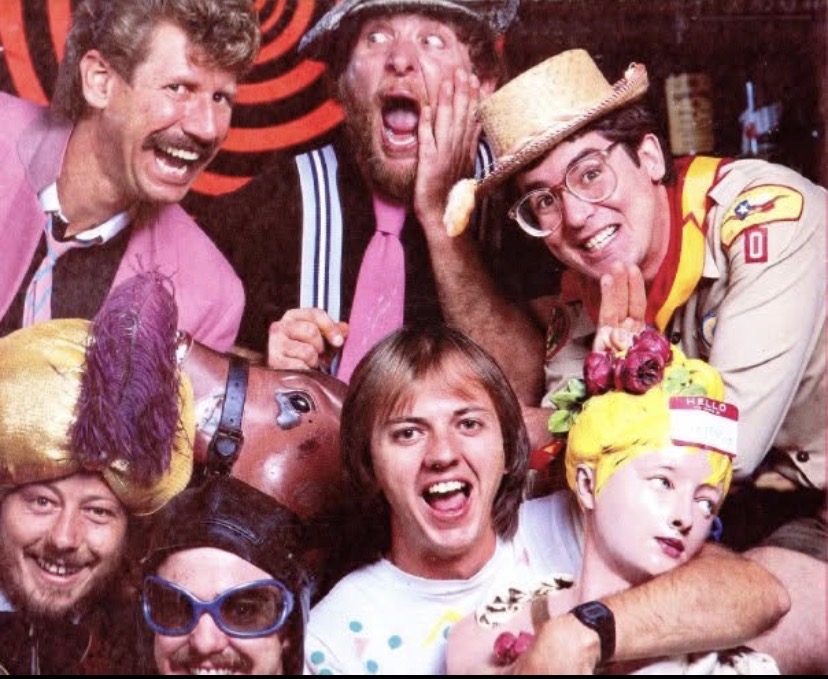
My predecessor as the group’s bassist was a fellow called Champagne Billy. He was appropriately inappropriate, loud, and, yes, very popular with patrons. He had charisma, sex appeal, and a raw, rakish bravado. That first night I appeared with the band, I could already sense many in the full house saying, “Who the hell is this clown?” and “What happened to Champagne Billy?”
“The Lion Sleeps Tonight” was fourth in the set list. I was a little nervous about trying to appease the Champagne Billy fans, but I felt confident about the song, which I’d sung many times before in other groups. Our version began with a keyboard figure that was vamped until my falsetto entered with “Doo-do-doo-do, da-doo-do-doo-do, the lion sleeps tonight.” Keyboard player Jimmy kicked off the repeated figure and I approached the microphone. I tried to start singing, but I knew something was off. I faltered, looking over at Jimmy, who was smiling and nodding and vamping away.
The Billy fans saw me struggling, and it started. “Get this guy off the stage!” “We want Champagne Billy!” It was nightmarish: drunk college kids becoming hostile, shouting for their macho bass player. I stood there before them, dressed in Boy Scout shorts and taped-up glasses, in their beloved Billy’s spot, obviously incompetent and out of place.
I had to wave Jimmy off. “Gotta start it over,” I yelled to him. “Wrong key.” The audience had had no idea that the key Jimmy was playing was several steps off, but I’d realized it right away. I might’ve been able to pull off a run-of-the-mill country song in a much lower key, but I knew that a pop song that’s built around a bright falsetto lead vocal would be disastrous sung in a Johnny Cash key. I gamely restarted the song and got through it, but I don’t imagine I won over any frat rats or sorority girls that night.
“The Lion Sleeps Tonight” is notable for being a monster 1961 #1 pop hit for a group of clean-cut white boys who called themselves the Tokens, despite its origin having been across the Atlantic Ocean in South Africa. It was first entitled “Mbube,” recorded in 1939 by an a cappella group, Solomon Linda’s Original Evening Birds. A decade before the Tokens got to it, Pete Seeger discovered it in 1951 and recorded it as “Wimoweh.” After the Tokens’ runaway success with their iteration, hundreds of other covers were released, and the song was included in the movie version of The Lion King.
And what did Solomon Linda get from his morphing, cash-cow, perennial favorite, “Mbube”/”Wimoweh”/”The Lion Sleeps Tonight”? He got nothing, after the ten shillings the original record company paid him. He died before his estate finally, after a lawsuit, was rewarded with rights and royalties.
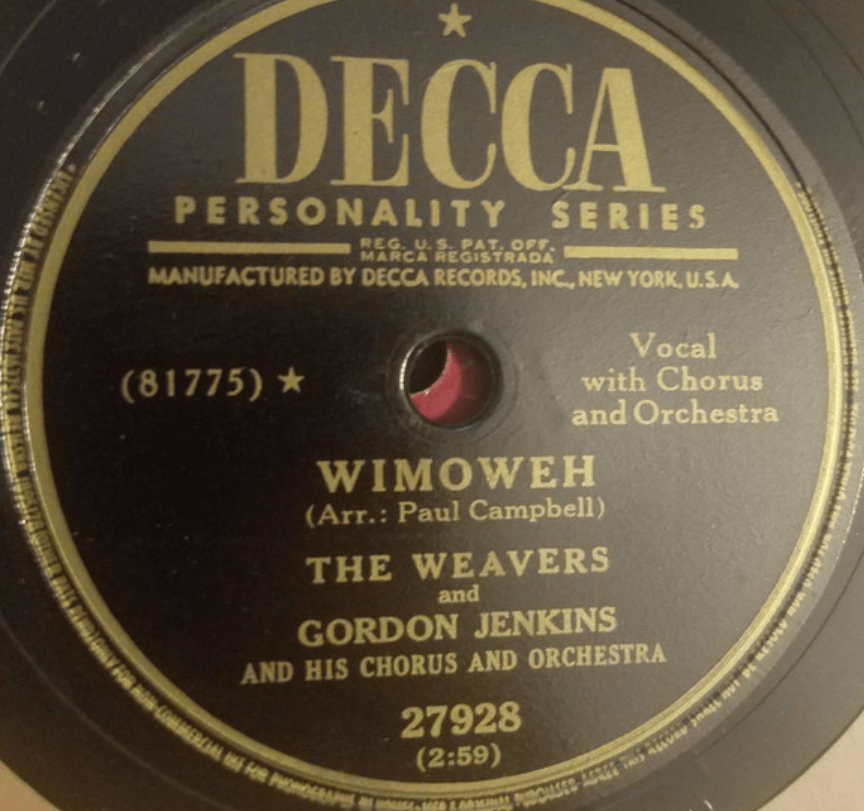
I stopped singing “The Lion Sleeps Tonight” long, long ago, and not because of my humiliation that night on stage with Bowley and Wilson. In fact, after that inauspicious debut performance, we kept it in the show for several months. It’s always a crowd-pleaser (unless the crowd is expecting Champagne Billy). I did it in several bands back in the day.
I had to stop doing it because my aging vocal cords could no longer finesse the requisite falsetto acrobatics of the Tokens’ version—the only version most people are familiar with. I do enjoy occasionally listening to “Mbube,” which is in a style carried along by, among others, Ladysmith Black Mambazo, a group Paul Simon and Graceland exposed to America. And the Weavers’ “Wimoweh” is a neat little curiosity piece. I’d be fine never hearing the Tokens’ “The Lion Sleeps Tonight” again. Still, I’m happy for the descendants of Solomon Linda that so many others still like to hear it and keep some royalties coming in.


Leave a comment